
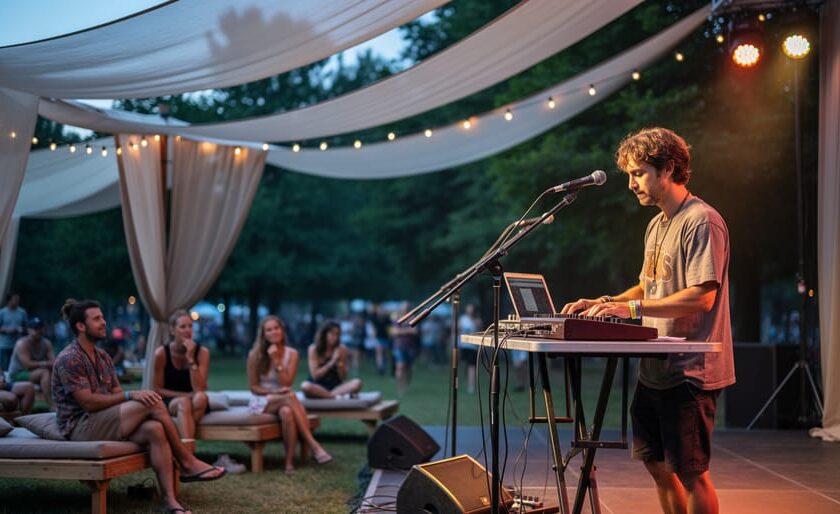
Multi-day festivals are intense, and finding pockets of calm between headliner sets can transform your experience from exhausting to euphoric. Live relaxing music at festivals includes everything from ambient electronic sets in chill-out tents and acoustic singer-songwriter sessions under shaded canopies to yoga soundbaths at sunrise and downtempo DJ sets designed specifically for recovery. These aren’t background playlists or recorded tracks. They’re performed by real artists who understand how to guide crowds from overstimulation back to baseline, creating intentional low-key moments that help you recharge before diving back into the chaos.
The best Canadian festivals have caught on to this need, and you’ll now find dedicated spaces programmed with soothing live acts throughout the weekend. But knowing which types of performances actually deliver that reset, and how to strategically fit them into your festival schedule, makes the difference between stumbling through day three on fumes or finishing strong.
Some festival veterans swear by catching an early-morning mantra circle before the grounds get crowded. Others hunt down those hidden forest stages where instrumentalists loop nature sounds into their sets. What matters is recognizing that relaxing live music at festivals serves a purpose beyond just variety. It’s recovery infrastructure, and learning to use it well turns a good festival into one you’ll remember for the right reasons.
How We Chose These Chill-Out Sets
We didn’t just toss together a list of slow songs and call it a day. These seven categories emerged from years of actual festival-going, countless conversations with fellow attendees in those precious chill zones, and honest trial-and-error about what actually helps you recharge versus what just sounds good on paper.
Our selection criteria focused on practical festival reality:
- Vibe consistency, does the performance genuinely create a calming atmosphere rather than just playing at a lower BPM?
- Festival accessibility, you can realistically find these types of sets at major multi-genre festivals, not just boutique wellness retreats
- Crowd reception, we watched how people actually respond, whether they stay, settle in, and visibly decompress
- Timing flexibility, these sets happen throughout the day, giving you options whenever burnout hits
- Legitimate relaxation value, they provide real physical and mental rest, not passive background noise
We’ve tested this firsthand, from collapsing into an ambient sunrise set after dancing until 4 a.m. to strategically hitting a jazz tent during the brutal afternoon heat. These picks reflect what’s worked when we genuinely needed to reset, not what theoretically should relax you.
1. Ambient Electronica at Sunrise Stages
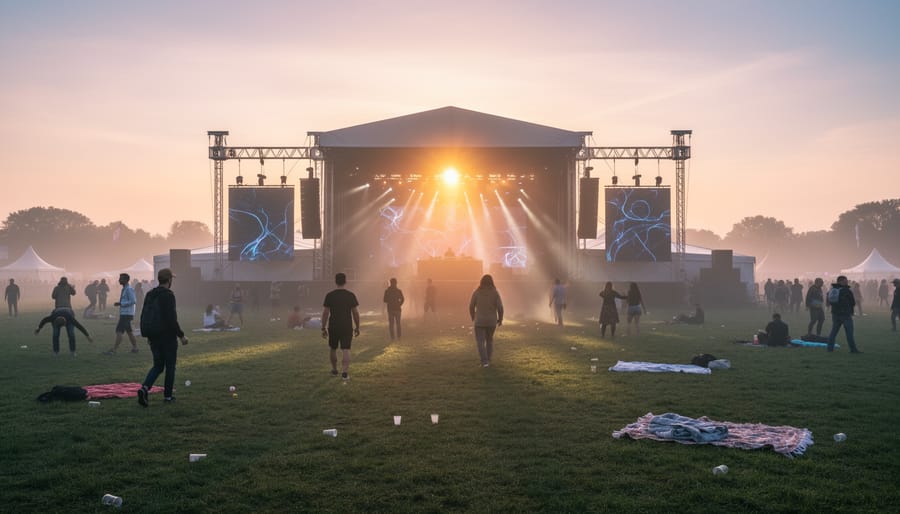
There’s something transcendent about catching an ambient electronica set as the sun creeps over a festival horizon. Artists in the Tycho, Bonobo, or Four Tet vein create soundscapes that match the quiet energy of dawn, soft synth pads, gentle beats, and evolving textures that help your body transition from the night’s chaos into a new day.
These sets typically unfold at dedicated sunrise stages or chill-out domes, spaces specifically designed for attendees coming down from headliner energy or starting their festival morning intentionally. The sonic palette leans heavily on analog warmth, field recordings, and hypnotic loops that never demand your full attention but reward it when you give it. Unlike traditional music performances that might appear later in quiet tents, ambient electronica thrives in that liminal 5am, 8am window.
Pro tip: check your festival app the night before and set a quiet alarm. These performances rarely conflict with anything else, and the crowd tends to be smaller, more present people seeking genuine restoration. Bring a light blanket and claim a spot near the back where you can lie down if needed. The combination of live electronic manipulation, gradual daylight, and fresh morning air creates a reset moment you simply can’t replicate at noon.
2. Acoustic Singer-Songwriter Sessions in Shade Tents
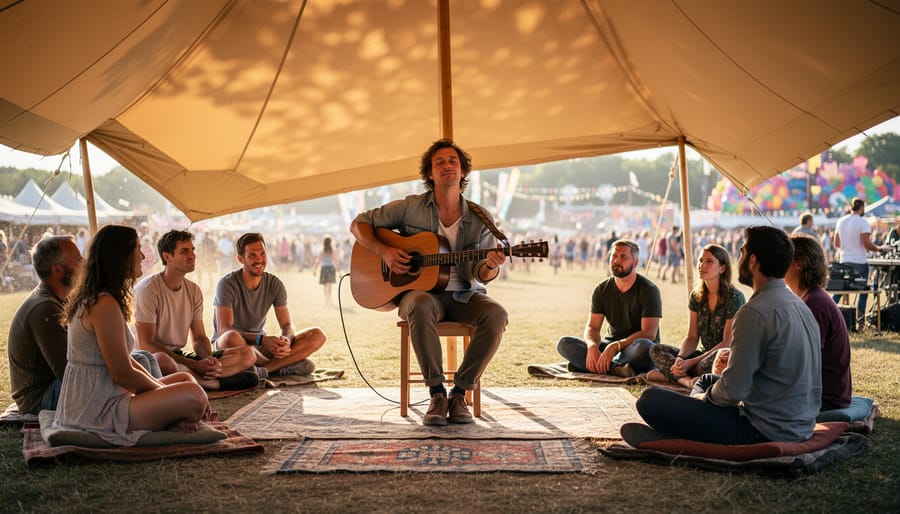
There’s something quietly transformative about stumbling into a shade tent mid-afternoon and discovering a singer-songwriter perched on a stool with just a guitar and a microphone. No pyrotechnics, no bass drops, just raw vocals and six strings cutting through the festival heat.
These acoustic sessions pop up in designated quiet zones at most major festivals, often tucked away from main thoroughfares. The intimacy catches you off guard. You’re close enough to see the musician’s fingers work the fretboard, close enough to hear them laugh between songs or share the story behind a lyric. It’s the polar opposite of watching a tiny figure on a distant stage through a sea of raised phones.
I once caught a completely unknown artist doing covers of ’90s indie tracks in a tiny tent at a UK festival. Twenty of us sat cross-legged on worn rugs while she reimagined songs we’d half-forgotten. When she finished, everyone just sat there for a beat before applauding. That stunned silence? You don’t get that anywhere else at a festival.
The beauty is the accessibility. You don’t need to stake out a spot hours early or fight through crowds. You wander in, sit down, and let someone’s voice wash over you while your feet recover and your ears get a break from relentless volume.
3. World Music & Instrumental Sets
There’s something transcendent about stumbling upon a handpan player tucked into a festival’s quieter corners, the metallic notes rippling through the air like water over stones. World music and instrumental sets tap into something deeper than language, creating meditative pockets where the festival’s frenzy melts away.
These performances typically feature traditional instruments you won’t hear on mainstream stages. Sitar players weaving complex ragas, classical guitar ensembles interpreting flamenco traditions, or percussionists coaxing rhythms from West African djembes. The hypnotic repetition and unfamiliar tonalities work differently on your nervous system than electronic beats, offering genuine mental decompression.
You’ll usually find these acts in dedicated world music stages or cultural pavilions, often sponsored by arts organizations or international cultural groups. Many festivals schedule them during afternoon slots when the main stages are relatively quiet. Look for wooden stages with ethnic decor, fabric drapes, or areas labeled “Global Village” or “World Stage” on your festival map.
The beauty here is accessibility. You don’t need musical knowledge to feel the calming effect of a shakuhachi flute or resonant hang drum. These instruments have been used for meditation and ceremony for centuries. Just claim a patch of grass, close your eyes, and let the unfamiliar become familiar.
4. Downtempo DJ Sets in Lounge Areas
Festival lounge areas host a special breed of DJ who understands that not every set needs to peak at 128 BPM. Downtempo DJs curate journeys through chill-hop, trip-hop, and lo-fi beats that give your nervous system permission to downshift without losing the music experience entirely.
What separates these sets from their main stage counterparts? The deliberate restraint. Instead of building toward a drop, downtempo DJs create horizontal soundscapes where beats roll consistently around 80-100 BPM. You’ll hear dusty samples, jazzy chord progressions, and subtle basslines that feel like a gentle massage for your overstimulated brain. Think Bonobo’s mellower moments or Nightmares on Wax vibes.
The beauty here is convenience. Most festivals tuck these lounge areas near food vendors or between stages, so you can recharge mid-day without the full commitment of hiking to a distant chill zone. I’ve salvaged countless festival Saturdays by spending 45 minutes in a bean bag while a DJ spins downtempo magic.
Timing matters: hit these spots during the brutal midday heat or that awkward 5-7pm window between afternoon and evening headliners. Bring a light blanket if you’re planning to post up, and don’t be surprised if you drift off for a power nap. That’s literally the point.
5. Neo-Classical & Modern Minimalist Performances
Contemporary classical and minimalist performances have carved out their own space at modern festivals, and for good reason. Artists working in the Ólafur Arnalds tradition, those blending piano, strings, and subtle electronics, create soundscapes that feel both ancient and futuristic. These sets typically happen in unconventional venues: art installations, geodesic domes, or repurposed warehouse spaces that festivals transform into intimate concert halls.
What makes these performances festival-friendly is their visual component. Many neo-classical artists incorporate projection mapping, subtle lighting design, or live-looped visuals that mirror the music’s gradual evolution. You’re not just listening; you’re inhabiting a crafted sensory experience that rewards stillness.
The sophistication doesn’t alienate festival crowds. I’ve watched bass-heavy ravers sit cross-legged through entire Max Richter-inspired sets, genuinely moved by layered piano phrases building over twenty minutes. There’s something about witnessing compositional complexity unfold live, seeing fingers on keys, bows on strings, that hits differently than electronic production.
Look for these performances scheduled during late afternoon or early evening, when the light transitions naturally support the music’s contemplative arc. Arrive early, because seating is usually limited and the dedicated fans stake their spots quickly.
6. Jazz Trios & Smooth Ensembles
Jazz trios tucked into festival beer gardens hit differently than any other chill-out option. There’s something about upright bass lines and brushed snares drifting over afternoon conversations that creates this perfect social-but-not-overwhelming atmosphere. Unlike ambient sets where everyone’s zoned out solo, jazz performances invite you to sit with friends, nurse a cold drink, and actually talk between songs without feeling like you’re disrupting the vibe.
Most mid-size and larger festivals now feature dedicated jazz tents or corner stages, typically programmed for those crucial 3-6 PM slots when you need a break but aren’t ready to retreat to your tent. The format works brilliantly: sets run 45-60 minutes, giving you a natural endpoint before heading back to main stages. I’ve found these spots become regular meetup points throughout the weekend, “Let’s catch whoever’s playing the jazz tent at four, then hit the main stage for the headliner.”
Look for trios and quartets over big bands; smaller ensembles suit the intimate festival setting better. Smooth, accessible players tend to get booked rather than experimental free jazz, which honestly makes sense for this context. Check your festival guide for beer garden programming, as these sets often aren’t promoted as heavily as main acts but deliver exactly what mid-afternoon festival bodies need.
7. Sound Healing & Meditation-Focused Live Sessions
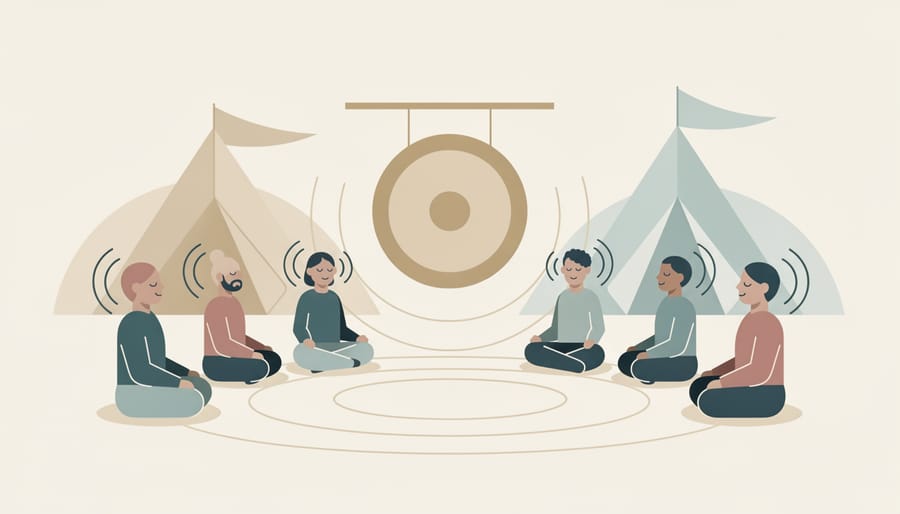
Sound healing sessions have evolved from fringe curiosities to legitimate festival programming, and honestly, they’re some of the most genuinely restorative experiences you’ll find on the grounds. These aren’t concerts in the traditional sense. You’re looking at gong baths where trained practitioners create layers of resonance that physically vibrate through your body, crystal singing bowl ceremonies that produce impossibly pure tones, and guided meditation sessions accompanied by ambient instrumentation.
What makes these sessions legitimately effective isn’t mystical, it’s neurological. The sustained frequencies and intentional sound patterns actually shift your brain from beta waves (alert, active) to alpha and theta states (relaxed, meditative). After two days of bass-heavy EDM and crowd chaos, your nervous system craves this reset.
Approaching these unconventional sets requires different etiquette. Arrive five minutes early since latecomers disrupt the carefully established atmosphere. Bring a mat or blanket, you’ll likely be lying down. Silence your phone completely. Don’t expect to stay awake through the whole thing; drifting in and out is normal and beneficial. Most festivals schedule these sessions mid-afternoon when you’d otherwise be napping in your tent anyway.
If you’re skeptical, try one short session before you plan your trip around them. The worst-case scenario? You get a guided nap. Best case? You discover a surprisingly powerful tool for managing festival fatigue.
Making the Most of Chill Zones at Any Festival
Chill zones work best when you treat them as part of your festival game plan, not just emergency recovery spots. Scout them out early on day one, check your festival map for acoustic tents, yoga domes, shade structures, or any area marked “wellness” or “lounge.” Once you know where they are, build short visits into your schedule rather than waiting until you’re completely wiped.
Pack smart for these breaks. A lightweight sarong or small blanket transforms any grassy spot into a comfortable landing pad, and a refillable water bottle is non-negotiable, dehydration kills your vibe faster than a dead phone battery. If you’re bouncing between loud stages and quiet zones, bring foam earplugs or musician’s earplugs so your ears get actual rest during downtempo sets instead of just different noise.
Timing matters more than you’d think. Midday sessions (1-4 PM) offer refuge from peak sun and crowd density, while late-night ambient sets around 2-3 AM can be beautifully surreal when main stages wind down. I’ve had some of my most memorable festival moments half-asleep under string lights during a 3 AM handpan performance, surrounded by others doing the same slow recharge.
The real skill is reading your own energy honestly. If you’re forcing yourself to catch every headliner while ignoring fatigue, you’ll remember the exhaustion more than the music. Balance is everything.
Common Questions About Festival Chill Zones
Most festival chill zones are included with your general admission ticket, though some wellness-focused areas or premium lounges might require separate booking. You’ll typically spot them on festival maps marked as “chill zone,” “wellness area,” or “quiet space,” often tucked away from main stages near the festival perimeter or in shaded sections.
Can I just camp out in a chill zone all day?
While you can definitely hang out for extended periods, many festivals encourage rotation during peak hours to give everyone access. Bring a blanket, claim your spot, but be cool about sharing the space.
What happens if I fall asleep during a set?
Totally normal and actually kind of the point. Security won’t wake you unless the zone is closing, though keep your valuables secure and maybe set a phone alarm if you need to catch a specific act later.
When are chill zones least crowded?
Early afternoon (1-3 PM) before the main schedule heats up, and surprisingly during headliner sets when most people are at the main stage. Sunrise sessions are also blissfully uncrowded.
Do I need special gear for these areas?
A light blanket or sarong is clutch for grass areas, and bring earplugs if you want to nap near ambient music. Some festivals provide cushions or bean bags, but don’t count on it.
The vibe in these spaces is genuinely communal. People respect the quiet-ish atmosphere, and you’ll often find fellow festival-goers who’ve discovered that pacing yourself makes the whole weekend better. Don’t stress about etiquette beyond basic courtesy and keeping noise levels down.
Treating festival chill zones as strategic rest stops, not afterthoughts, fundamentally changes how you experience multi-day events. These relaxing live sets aren’t just background music, they’re your reset button, letting you recharge physically and mentally so you can actually enjoy the headliners instead of dragging yourself through them on fumes.
The festivals I remember most aren’t just defined by the main stage explosions. They’re the ambient sunrise set where I watched fog lift over the valley, the impromptu jazz trio that soundtracked the best conversations, the crystal bowl session that somehow reset my entire nervous system after two sleepless nights. Those quieter corners gave me the space to actually be present for the chaos.
Don’t skip the chill zones thinking you’ll miss out. You’ll miss far more by burning out Saturday afternoon. Explore these spaces, let yourself slow down, and remember that great festival experiences need breathing room between the breathless moments.